















The Two Fridas, Painted the Year of the Divorce
The Two Fridas (Las dos Fridas) is Frida Kahlo's largest canvas, roughly 1.7 meters on each side, and she painted it in 1939 while her marriage to Diego Rivera was coming apart. Two versions of the artist sit side by side on a low bench under a stormy sky, holding hands. The Frida on the left wears a white European lace dress. The one on the right wears the Tehuana dress Rivera loved. Both have their hearts painted on the outside of their chests.
A single vein ties the picture together. It begins at a tiny portrait of Rivera as a boy, held in the Tehuana Frida's hand, passes through both hearts, and ends in a pair of surgical forceps resting on the European Frida's lap. The forceps fail to close it: blood drips onto the white skirt. Kahlo gave two explanations over the years, a memory of an imaginary childhood friend, and the two selves the divorce split apart, the woman Diego had loved in Mexican dress and the one he left behind.
The painting appeared at the International Surrealism Exhibition in Mexico City in 1940 and now belongs to the Museo de Arte Moderno there. If you ever get to see a single Kahlo in person, this is the one most people would send you to.
How Frida Painted Herself
Kahlo came to painting sideways. A bus accident in 1925 left the eighteen-year-old in a body cast, and she began painting from bed with a mirror mounted above her. About a third of the roughly 140 paintings she finished are self-portraits. "I paint myself because I am so often alone," she said, "and because I am the subject I know best."
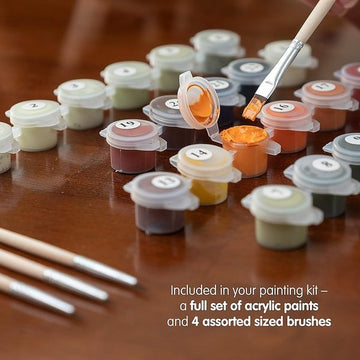
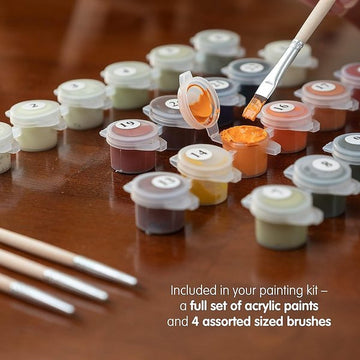
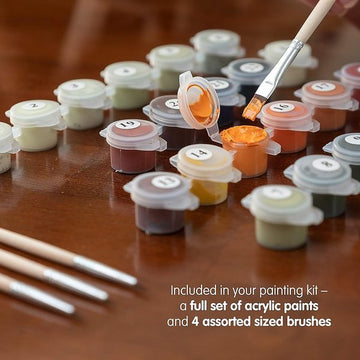
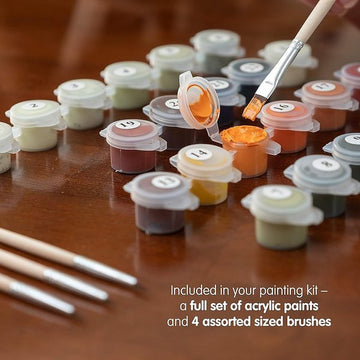
Our Frida Kahlo kit adapts another of those self-portraits, Self-Portrait with Thorn Necklace and Hummingbird from 1940: the one with a spider monkey over one shoulder, a black cat over the other, and a hummingbird hanging from a necklace of thorns. The original hangs at the Harry Ransom Center in Austin, Texas. The numbered version keeps the braided hair, the butterflies and the wall of green leaves behind her, divided into zones you fill one pre-mixed pot at a time. If you want to paint like Frida without a decade of practice, this is the honest shortcut.
Want to paint this yourself?
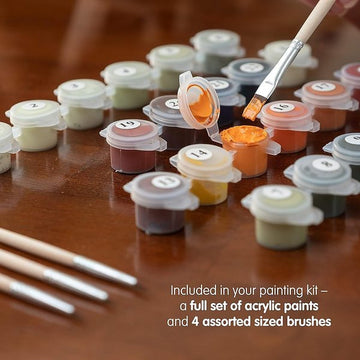
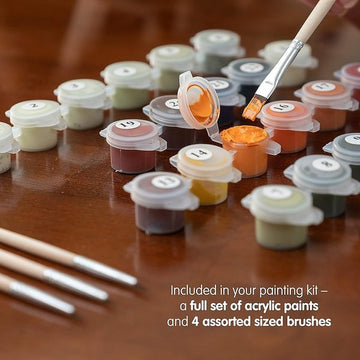
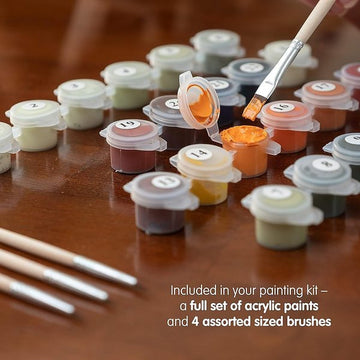
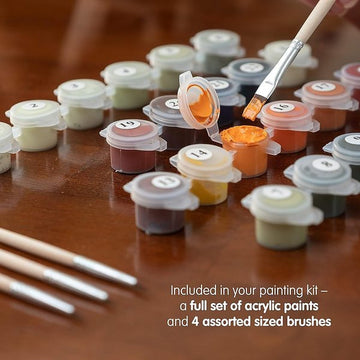
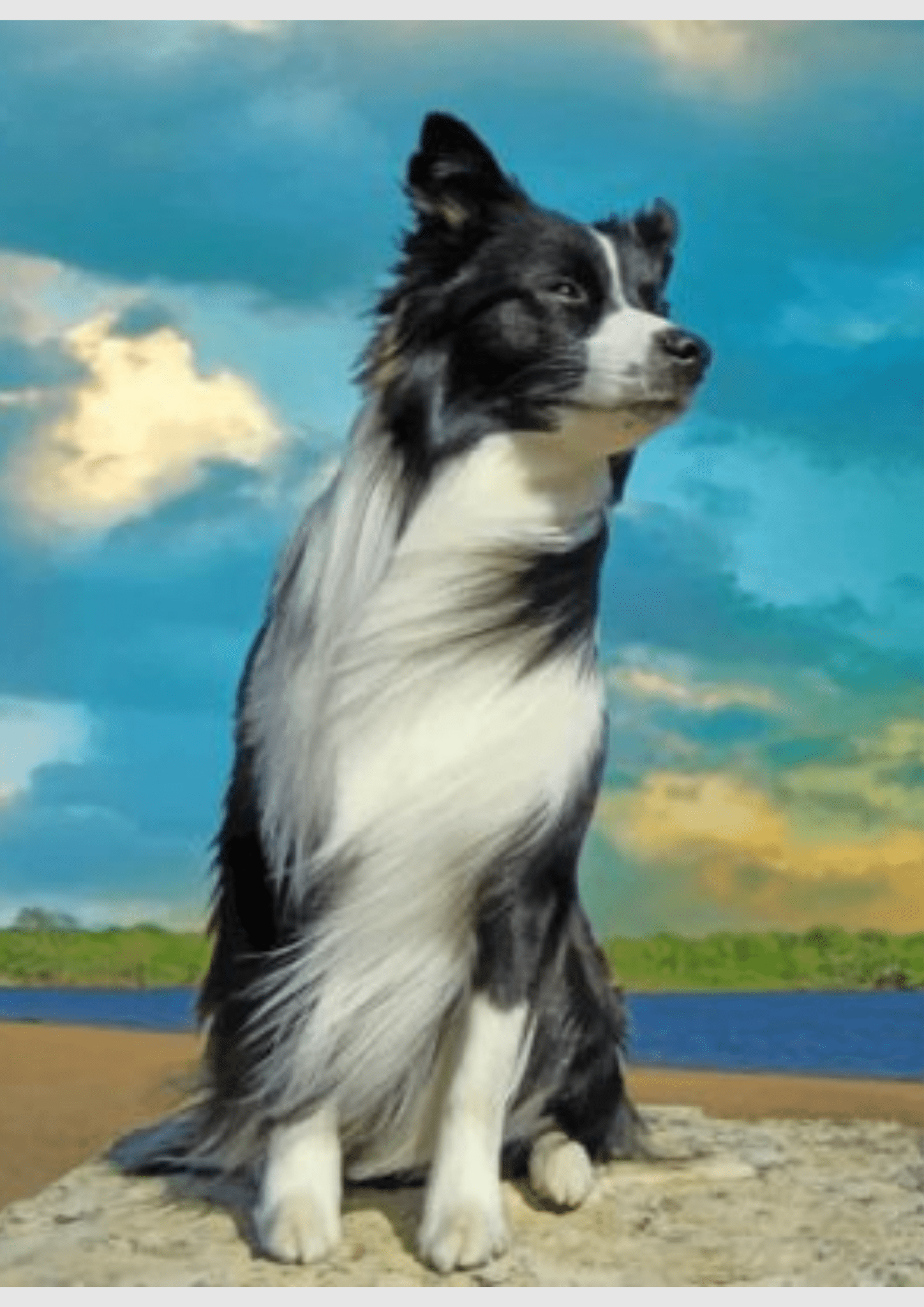
Turn one of your own photos into a numbered canvas (from $19.95). We trace it, mix the paints to match, and ship the kit with brushes.
Or pick a ready-made design
- Frida Kahlo Premium Paint by Numbers Kit for Adults (from $19.95)
- Abstract Cosmos Premium Paint by Numbers Kit for Adults (from $19.95)
- Abstract Cat Premium Paint by Numbers Kit for Adults (from $19.95)
- Abstract Floral Swirls - Premium Art Kit (from $19.95)
Matisse and the Goldfish
Henri Matisse painted goldfish again and again between 1912 and 1914. The habit started in Morocco: during his 1912 stay in Tangier he watched men sit for long stretches contemplating goldfish in glass bowls, and that mix of stillness and pure orange stayed with him. The best-known result, titled simply Goldfish, shows four fish in a cylindrical tank on a round garden table surrounded by greenery. You see each fish twice, sharply through the side of the glass and blurred from above through the water's surface. It hangs in the Pushkin State Museum of Fine Arts in Moscow.
Matisse had led the Fauves, the painters a critic dismissed as "wild beasts" at the 1905 Salon d'Automne for their raw, unmixed color. The goldfish pictures are that idea at its most concentrated: a small patch of intense orange set against a whole canvas of greens and pinks. A later variation, Goldfish and Palette from 1914, pushed the scene toward abstraction and now belongs to the Museum of Modern Art in New York. The mechanics of why orange hums against green are in our color theory guide, under complementary pairs.
Abstract Art by Wassily Kandinsky
Wassily Kandinsky gave up a law career in Moscow at thirty, moved to Munich, and spent the following decades arguing that painting should work the way music does: directly on the senses, with no need to depict anything. He described experiencing color as sound, writing in his 1911 book Concerning the Spiritual in Art that vermilion rings "like a great trumpet."
Composition 8, painted in 1923 while he taught at the Bauhaus, is the version of that idea most people meet first. Circles, grids and wedges of color are arranged like a score, with a large dark circle in the upper left anchoring the whole. Solomon R. Guggenheim bought it from the artist, and it remains a centerpiece of the Guggenheim Museum in New York. The earlier Composition 7 of 1913, kept at the Tretyakov Gallery in Moscow, is wilder: a storm of color Kandinsky prepared with more than thirty studies, then painted in a matter of days.
What Is Abstractionism?
Abstractionism, or abstract art, is painting that does not set out to depict recognizable things. Shape, color, line and texture carry the picture on their own. There are degrees of it. A Kandinsky from 1911 still hides riders and hills inside its swirls, while Composition 8 keeps no visible subject at all. Kandinsky was among the first to cross that line completely, alongside Hilma af Klint and Kazimir Malevich, each arriving there separately in the 1910s.
After the Second World War the center of abstraction moved to New York, where abstract expressionism split into two tempers. One was gestural, Jackson Pollock's poured and flung lines. The other was color field painting: Mark Rothko stacking soft-edged rectangles of color meant to be stood close to, Barnett Newman dividing tall canvases with single vertical stripes he called zips. A color field painting is not about what it shows. It is about what the color does to you while you stand in front of it.
Painting Colorful Abstract Art Yourself
Abstract designs suit paint by numbers unusually well, because nothing has to "look right". There is no face to get wrong, only zones of color, and bold flat zones are exactly what the format does best. Our abstract collection gathers dozens of colorful abstract paintings in kit form.
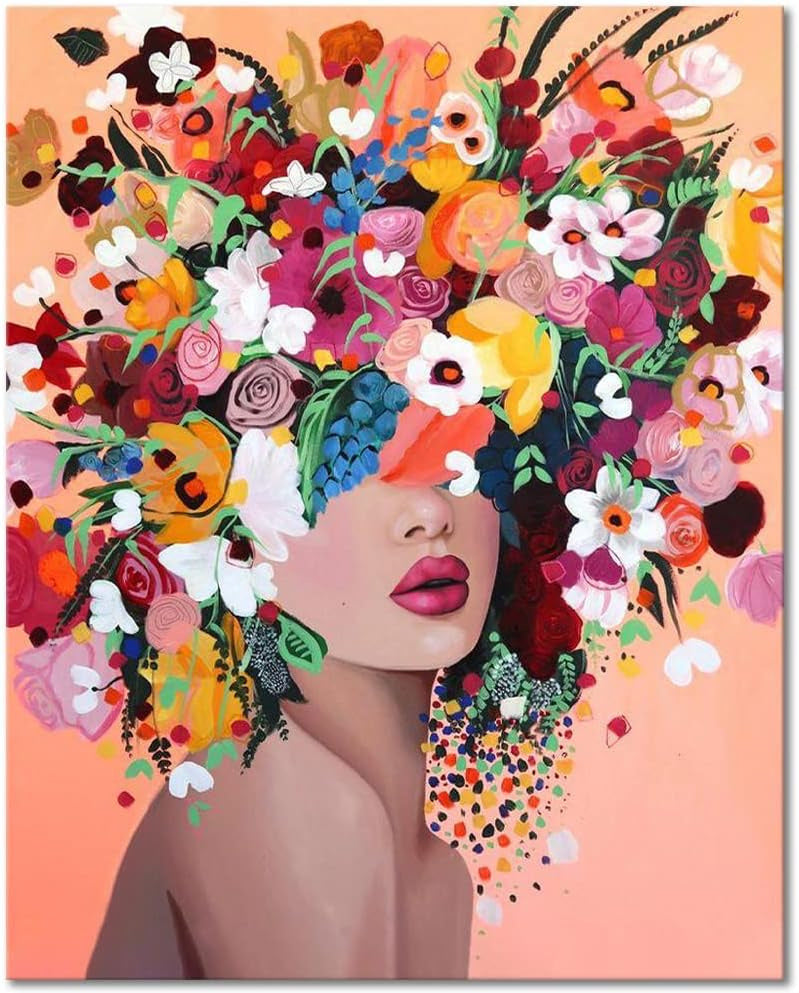
A few starting points. Abstract Cosmos is a swirl of planets and glossy spheres in reds, blues and golds on a near-black ground, the loudest design on this page after the Kandinsky. Abstract Cat turns a cat's face into facets of teal, violet and orange among jungle leaves, the pick if you came here looking for an abstract painting of an animal. Abstract Floral Swirls builds a single flower out of paisley curls of turquoise and amber, closer to a mandala than a bouquet. And Abstract Expressionism, true to its name, is palette-knife blocks of orange, teal and navy with no subject at all.
If the famous originals are more your speed, the famous paintings collection runs from Klimt to Hokusai, and we covered Van Gogh's Starry Night and his other major works in a separate guide.
No experience needed. Money-back guarantee.
Free shipping to the US, Canada, the UK, the EU, Australia and New Zealand, with no minimum order. Buy two kits and the third is free, applied automatically at checkout.