Anime backgrounds are built from flat areas of colour with hard edges between them. There's very little blending, which is good news if you're new to paint by numbers: you don't need to mix or shade anything. It also means mistakes show. A patchy sky or a wobbly line around a figure is easy to spot when everything around it is clean.
These tips come from the questions we get most about our anime kits. They apply to any of them, but we'll use a few specific scenes as examples.
The short version
- Fill the largest areas first, then work towards the details.
- Two thin coats cover better than one heavy one.
- Paint edges with the fine brush, from inside the shape outwards.
- Light colours on top of dark numbers need a second coat.
Start with the big areas
Open the kit and find the numbers that cover the most canvas. In most anime scenes that's the sky. On Rooftop Sunset, the sky is painted in wide bands of orange, pink and violet, and those bands take up close to half the canvas. Filling them first gives you something that already looks like a painting after one session, which helps with motivation.
There's a practical reason too. Large areas are where the brush is least precise, and painting them early means any paint that strays over a line will later be covered by the smaller shapes painted on top. Working the other way round, you'd be painting carefully around details you've already finished.
Thin coats, not thick ones
The paint in our kits is water-based acrylic. It dries in a few minutes, and it's tempting to load the brush and cover an area in one go. Thick paint leaves ridges, takes longer to dry through, and tends to pull away from the edges of the shape. Put down a thin layer, let it dry to the touch, then add a second. Two thin coats cover better than one heavy one, and the surface comes out flatter, which is exactly the look anime backgrounds are going for.
If the first coat looks streaky, that's normal. Don't go back into it while it's still wet. Wait, then cover it.
Keeping the edges sharp
Hard edges are what make an anime scene read as anime. Use the finest brush in the kit for the outline of each area, and fill the middle with a wider one. Start a little inside the shape and draw the brush towards the line, rather than along it from outside. You'll stop where you mean to more often.
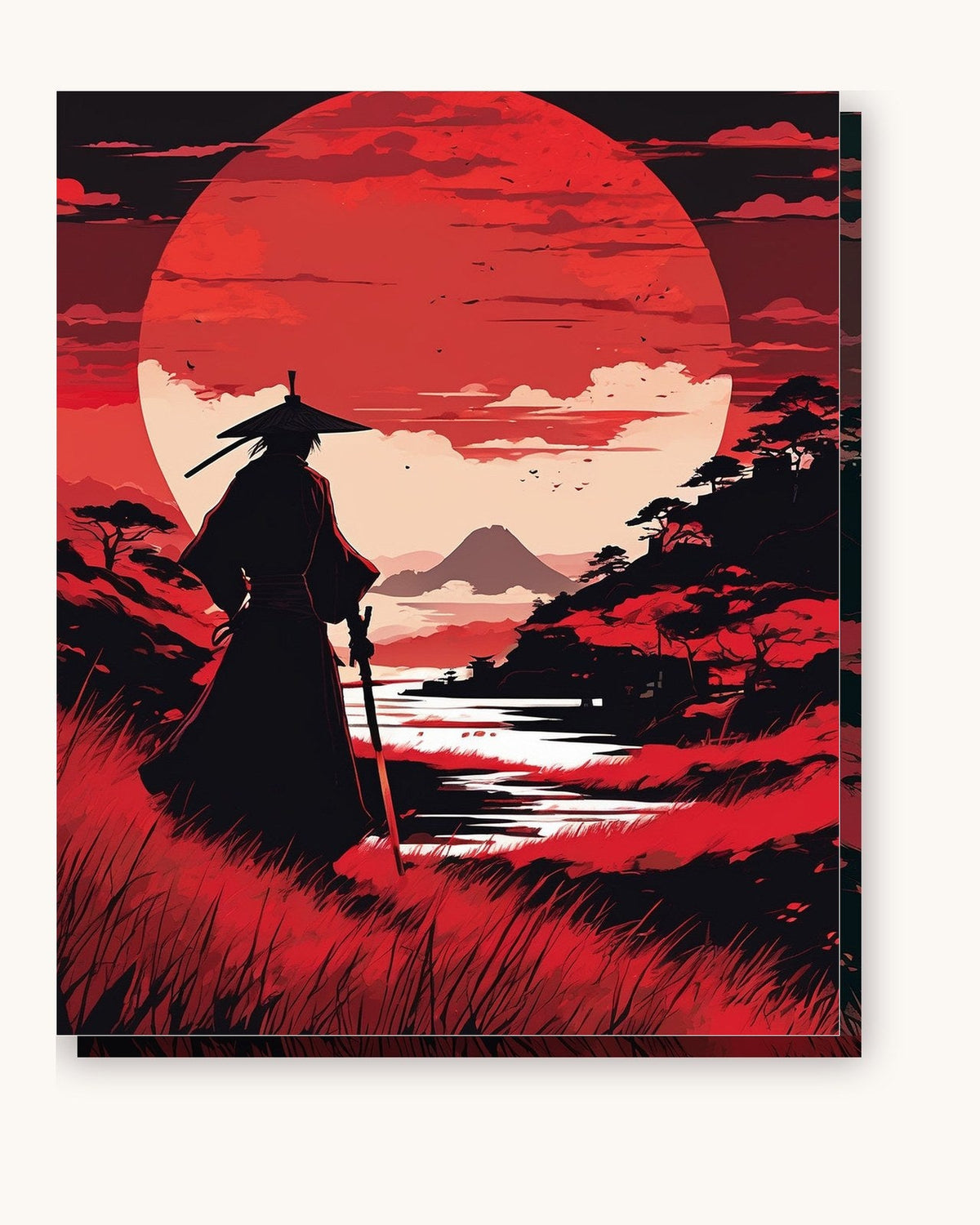
Turn the canvas as you go. Your hand is steadier pulling in one direction than another, so rotate the work until the edge you're painting sits at a comfortable angle. On Samurai under a Red Moon, the figure is a dark silhouette against a huge red moon, and the outline of the hat and sword is the whole picture. It's worth slowing down there, turning the canvas a quarter at a time, and doing the curve in short strokes.
Light colours over dark numbers
The printed numbers and lines on the canvas are dark. A pale colour painted over them in a single coat will often let them show through, and so will a dark area you've slightly overpainted. The fix is a second coat once the first is dry, sometimes a third for white.
Girl and Black Cat on the Rooftop is the clearest example. The city below is full of small amber windows against a navy sky, and the moon is white. Paint the navy first, then the windows and the moon, and plan on two coats for each of the light areas. It's slower, but those small lit windows are what make the scene work.
Keeping the paint usable
Close each pot as soon as you've finished with that number, even if you'll use it again later in the session. Acrylic dries quickly, and an open pot skins over. If a colour has started to thicken, add one drop of clean water and stir it with the end of the brush. Go carefully: too much water makes the paint transparent, and you're back to extra coats.
Rinse brushes in water between colours and before the paint dries in the bristles. A fine brush with dried acrylic at the tip won't give you a clean edge again.
Painting your own character
If you draw, all of this applies to your own art too. Original characters drawn in flat colour translate well into numbered canvases, and a custom kit lets you paint one. Most of the scenes in the anime collection are a good first try before that, and our anime paint by numbers guide can help you pick one by mood or difficulty.