A painting for a reading corner can show the things that make you want to sit there: a shelf full of books, a pool of window light, the cat that occupies your chair. The choice is less about finding a picture of a book than choosing the kind of scene you want to spend time painting.
Two catalog kits offer different versions of that room. Bookshelf Cat has strong shelf lines and bright book spines around an orange-and-white cat. Tabby Cat and Books brings together a striped cat, a window, stacked books and a cup. Here is what to compare before choosing between them.
Choose by composition
- Bookshelf Cat suits someone drawn to repeated shelf shapes and a colorful, graphic scene.
- Tabby Cat and Books suits someone who prefers a window-side still life with fur, plants and books sharing the picture.
The two scenes at a glance
| What you want to paint | Bookshelf Cat | Tabby Cat and Books |
|---|---|---|
| Main setting | Bookcase filling much of the image | Cat beside a window and stacked books |
| Visible structure | Shelf horizontals and upright book spines | Window edges, horizontal book stacks and the cat's body |
| Main contrast | Orange-and-white cat against darker shelves | Striped coat beside pale window light |
| Extra subjects | Books and a small plant | Cup, plant, books and window |
These are observations of the finished catalog images. They do not establish how many tiny sections the numbered pattern contains or how long either kit will take.
Bookshelf Cat: shelves are part of the subject
In Bookshelf Cat, the books are more than a prop under the animal. They fill the scene with repeated vertical shapes. The orange-and-white cat sits among them, with its tail dropping across the lower part of the composition.
Choose this image if you like the relationship between straight shelves and the curved outline of an animal. The finished illustration has warm oranges alongside teal and green book colors. Its dark shelf openings help the pale chest and face stand out.

For the painting itself, keep an eye on the joins where a book spine meets the shelf above or below it. Follow the actual printed boundaries rather than trying to make every book into a perfect rectangle from memory. A shelf scene can contain angled books and irregular edges as well as straight lines.
Leave the original reference image available while you work. It will help you recognise which shapes belong to the books, the shelf openings or the cat when the numbered canvas looks less obvious. Do not choose this kit expecting to reproduce readable book titles: the attraction is the arrangement and color of the books.
Tabby Cat and Books: a room around the animal
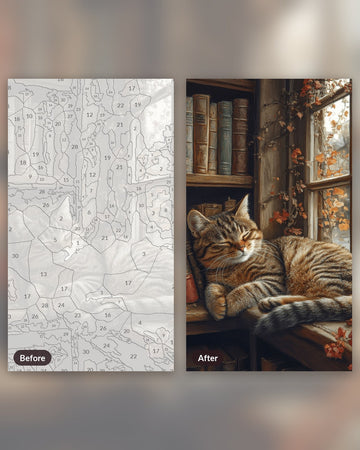
Tabby Cat and Books has a different center of gravity. The striped cat lies beside a window, above a stack of books. A cup and a potted plant occupy the lower and left-hand parts of the scene.
The books read as a place the cat has claimed. They support the image without filling every part of it. Choose this composition if the window-side atmosphere appeals to you as much as the animal.

There are different kinds of edges to keep track of here: the window frame, book covers, leaf shapes and changes in the coat. When a section becomes hard to identify, return to the reference rather than inventing a stripe or connecting two shapes because they appear similar.
You do not need to blend away every boundary in a numbered portrait. Follow the supplied pattern first and let the surrounding areas develop before judging one isolated patch of fur. The finished effect depends on neighboring colors as well as the color in the pot.
Which one would you enjoy working on?
Start with the part you notice first. If your eye goes straight to the bookcase, Bookshelf Cat is the stronger candidate. If it goes to the cat beside the window, consider Tabby Cat and Books.
Then look at the background. You will paint that too. Someone who likes painting animals but dislikes repeated shelf shapes may prefer the window scene. Someone who enjoys arranging colors across a page may find the rows of book spines more appealing.
Do not use the number of visible objects as a difficulty score. One broad-looking area in a finished picture can contain several numbered regions; a detailed-looking book may be simplified in the pattern. The catalog illustration alone cannot settle that question. Check the product's current options and choose a level of detail you want to work with, without assuming that fewer colors always means larger sections or a quick finish.
Fit the painting to the corner
Measure the available wall space and the surface where you will paint. Both measurements matter. A canvas can fit beside a bookcase while still being awkward on a crowded desk.
The canvas-size guide explains the available formats. Look at the final composition as well as the dimensions; a square and a rectangle need not frame the same scene in exactly the same way. Check the selected product option rather than assuming a catalog mockup shows every available format.
If you plan to hang the result, decide how you will mount it before buying a separate frame. The framing guide covers ways to finish an unmounted canvas. Selecting the DIY Frame Kit supplies bars you assemble yourself. It is a separate decision from choosing the picture.
For a reading corner that is already personal, these two scenes offer a simple choice: the book-filled shelf or the window-side companion. If the room you want to paint is your own, the custom photo kit is another route. A clear photograph of your favorite chair, shelves or sleeping cat gives you a starting point that belongs to that particular room.