

















What Are Tertiary Colors? The Definition and All Six Names
Tertiary colors are made by mixing a primary color with the secondary color sitting next to it on the color wheel. Red mixed with orange gives red-orange. Blue mixed with green gives blue-green. There are six of them in the traditional wheel, and together with the three primaries and three secondaries they complete the 12-color wheel most artists learn first.
They matter because almost nothing in the real world is a pure primary. Skin, foliage, sunsets, sea water: nearly all of it lives in tertiary territory.
Want to paint this yourself?
Turn one of your own photos into a numbered canvas (from $19.95). We trace it, mix the paints to match, and ship the kit with brushes.
Or pick a ready-made design
- Abstract Cosmos Premium Paint by Numbers Kit for Adults (from $19.95)
- Sunset Pier Premium Paint by Numbers Kit for Adults (from $19.95)
- Cozy Forest Escape Paint by Numbers Kit for Adults (from $19.95)
The Six Tertiary Colors
Each one is named primary first, secondary second. Several also have everyday names you already know:
- Red-orange, close to vermilion. Embers, terracotta, autumn leaves at their brightest.
- Yellow-orange, often called amber. Honey, golden-hour light.
- Yellow-green, known as chartreuse. New spring growth, limes.
- Blue-green, the family of teal and turquoise. Tropical water, patinated copper.
- Blue-violet. Twilight skies, irises.
- Red-violet, near magenta. Fuchsias, plums, bougainvillea.
The naming convention is not decoration. "Red-orange" tells you the recipe: start from red, pull it toward orange.
How Do You Obtain Tertiary Colors?
Mix a primary with its neighboring secondary in roughly equal parts, then adjust. More primary shifts the result toward the spoke you started from; more secondary pushes it the other way. Blue plus green in even amounts lands on a balanced blue-green, while a touch more blue takes it toward a deep teal.
Two things to watch when mixing physical paint. First, use a secondary that actually contains your primary: mixing red into a green (which contains no red) gives mud, not a tertiary. Second, add the darker paint to the lighter one in small steps, because a dark hue overpowers a light one far faster than the reverse.
Primary, Secondary and Tertiary Colors on the Wheel
The classic wheel builds up in three layers. Three primaries, red, yellow and blue, which cannot be mixed from anything else. Three secondaries, orange, green and violet, each mixed from two primaries. Six tertiaries filling the gaps between a primary and a secondary. That gives the 12 evenly spaced hues of the standard artist's wheel, a scheme descended from the color circle Isaac Newton first drew in the 1660s.
Once the twelve spokes are in place, every other relationship painters talk about, complements across the wheel or analogous colors beside each other, is read straight off this layout. Our color theory basics guide walks through those relationships one by one.
The Other Meaning of Tertiary
Some art teachers use "tertiary" differently: for colors mixed from two secondaries. Orange plus green gives citron, orange plus violet gives russet, green plus violet gives olive or slate. Because every one of these contains all three primaries, they come out muted, the browns, khakis and grays that do so much quiet work in realistic painting. Both definitions are in circulation, so when a tutorial says tertiary, check which recipe it means. On the 12-color wheel itself, the primary-plus-secondary definition is the standard one.
Tertiary Colors in a Paint by Numbers Kit
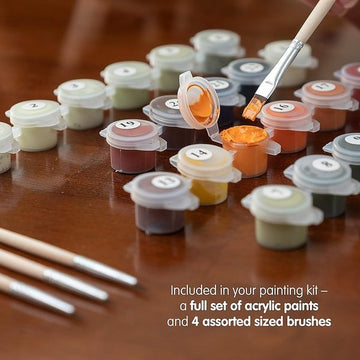
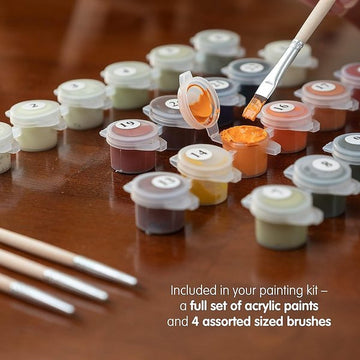
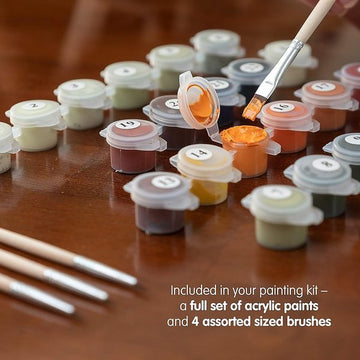
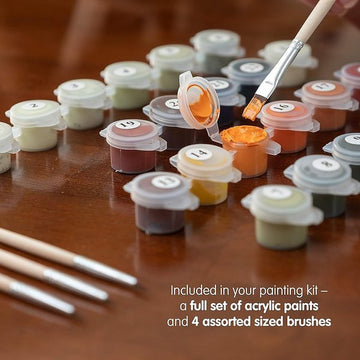
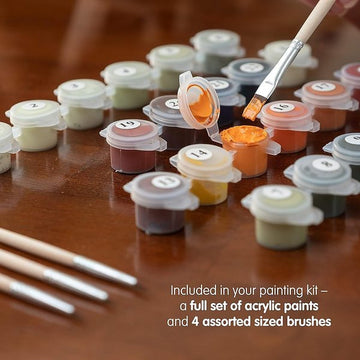
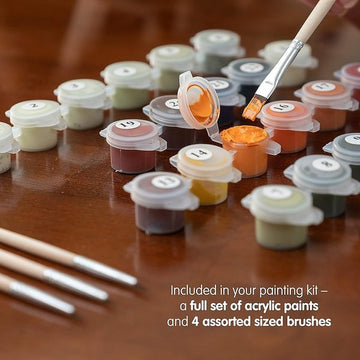
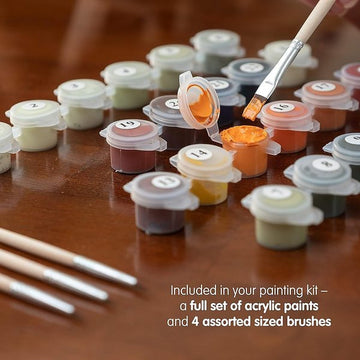
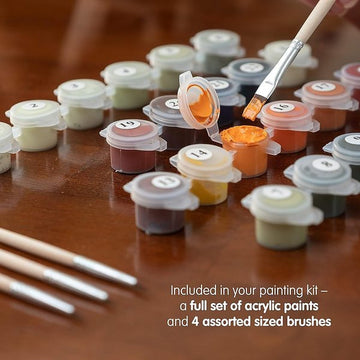
Open one of our kits and count the pots: 24 to 48 pre-mixed paints for a single picture, on canvases from 12x12 up to 23.5x23.5 inches. Only a handful are primaries or secondaries. The rest are tertiaries and their lighter and darker versions, because that is what a believable sky, face or forest actually requires. Painting by numbers is a fairly painless way to learn this: after one landscape you will have handled more variations of blue-green than most people name in a lifetime.
No experience needed. Money-back guarantee.
Free shipping to the US, Canada, the UK, the EU, Australia and New Zealand, with no minimum order. Buy two kits and the third is free, applied automatically at checkout.