A bird kit includes everything around the bird. Before choosing, look at the branches, flowers and background as carefully as the feathers. A cardinal surrounded by berry clusters gives you a different painting project from a bluebird on a fence post, even when both canvases are the same size.
The five designs below are compared from their current catalogue artwork and listed options. The artwork helps you judge the subject and composition; it does not show the complete numbered map for every size and palette. Treat the detail observations as things to examine, rather than a promise of a particular difficulty or finishing time.
Compare the work around the bird
| Kit | Bird within the scene | Surrounding work to consider |
|---|---|---|
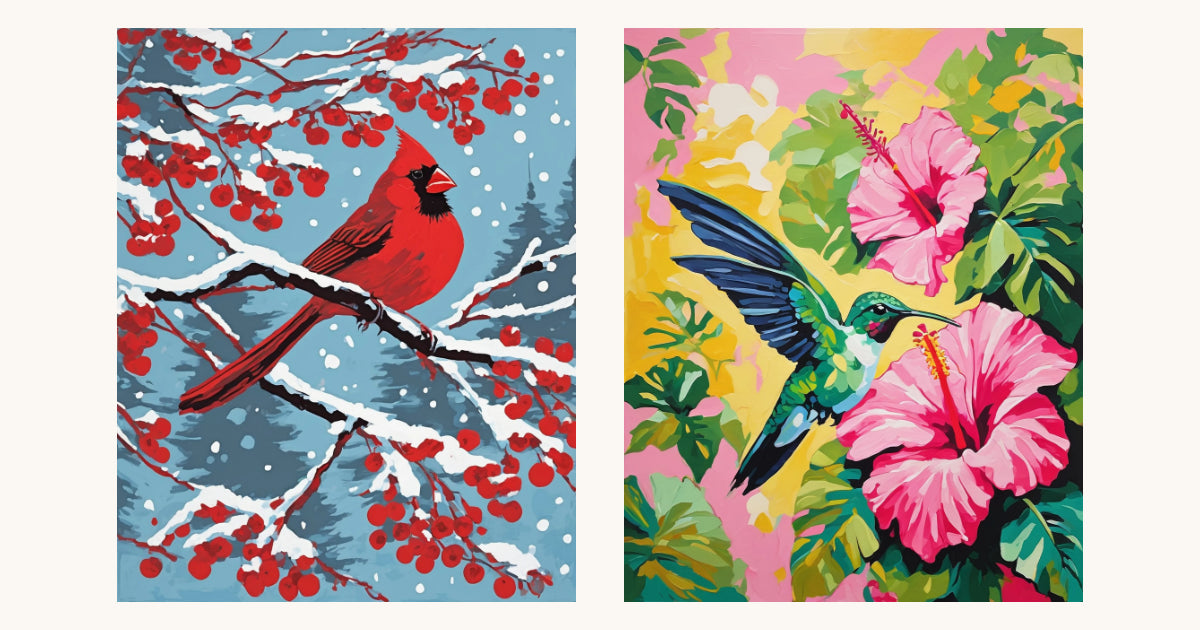
| Cardinal in the Winter Berries | Large red profile with a dark face and striped wing | Repeated berry clusters, snowy branches and distant tree shapes |
| Cardinal on the Snowy Pine | Red bird facing left, with warm brown areas across its wing | Long pine needles, snow and a softer blue background |
| Bluebird on a Fence Post | Blue and warm brown profile above a substantial post | Vertical wood marks, meadow flowers and distant landscape |
| Hummingbird and Orange Trumpet Flowers | Central bird with a raised, segmented wing | Orange flower shapes and a dense green setting |
| Hummingbird and Pink Hibiscus | Green bird with a broad dark blue wing | Large pink petals, flower centers and leafy shapes |
Choose a scene whose surrounding work interests you. The bird may be the reason you buy it, but those other shapes will also be under your brush.
Two cardinals, two kinds of branch detail

Cardinal in the Winter Berries gives the red bird a clear presence against blue. Berry clusters repeat around the top and lower edges, while dark branches cross the pale snow. Look closely at those repeated rounded forms before deciding: they occupy a substantial part of the composition.
The black face and dark lines across the wing provide a different task from the broader red body. If the contrast between red, dark markings and pale snow is what attracts you, make sure you also want to paint the berry-laden frame around it.

Cardinal on the Snowy Pine faces the opposite way. Long needles and snow-covered branches run diagonally around the bird. The wing includes warm brown areas, and the background looks more open than the berry-heavy scene.
That open appearance does not prove the printed canvas contains only large regions. Inspect the pine needles, feet and wing markings as well as the sky. Between these two, choose berries if you want repeated rounded accents; choose pine if the long, narrow foliage is part of the appeal.
A bluebird with a prominent perch

Bluebird on a Fence Post places a blue and warm brown bird over a tall gray post. The horizontal rail cuts across the scene, giving the composition a strong structure beneath the feather shapes.
The post is a subject in its own right. Light and dark vertical marks suggest worn wood, while small flower shapes continue through the green meadow. This is a useful choice to examine if you want a bird painting with a clear perch and a landscape behind it.
Check the lower half of the picture before choosing. If only the bird interests you, the amount of meadow detail may matter more than its gentle green appearance suggests. If you enjoy alternating between an animal, weathered wood and small floral accents, those changes are part of this design's attraction.
Two hummingbirds with different flower shapes

Hummingbird and Orange Trumpet Flowers puts a long beak and an extended wing at the center of orange and green. The wing is divided visually into narrow feather shapes; smaller dark and red markings appear around the head and throat.
The flowers are prominent too. Their warm petals and projecting centers break up the foliage, so this is as much a flower-and-bird composition as an isolated bird portrait. Compare the wing and the flower centers at an enlarged view. Both contain the kind of fine shapes you may want to work on slowly.

Hummingbird and Pink Hibiscus has a different balance. Large pink petals sit close to the green bird, and a dark blue wing stretches toward the left edge. Yellow and pink areas lighten the background between the leaves.
The broad flower silhouettes may be what catches your eye, but the petals contain visible changes from pale pink to deeper red. Flower centers and feather markings add smaller accents. Choose this scene because you want both the hibiscus and the bird; the large flowers take up too much of the composition to be an incidental background.
Match the canvas option to the details you want
These five product pages list 30 × 30 cm, 30 × 40 cm, 40 × 50 cm, 50 × 65 cm and 60 × 60 cm sizes, with 24, 36 or 48 colors. Start with how much space the bird occupies in the whole image. A larger canvas also gives space to the branches and flowers; the size label alone does not describe the bird's scale.
Check the square option against the rectangular composition before ordering. Keep the beak, tail and wing tips in mind, together with any branch or flower you particularly want included. If the final crop for your chosen option is unclear, ask before buying rather than assuming that every format preserves the same edges.
Fewer colors do not guarantee larger printed regions or an easier painting. A limited palette can still have narrow feathers, many berries or thin stems. Consider the shapes you enjoy filling and the amount of repetition you want.
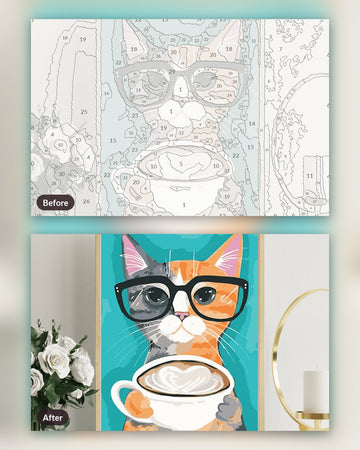
The frame choice is also separate. A catalogue mockup may show a mounted picture, but “DIY Frame Kit” means bars you assemble yourself. Check the selected option rather than treating the display image as the contents of the box.
For a closer comparison of dimensions, use the canvas size guide alongside the size options on the product page.
Pick the area you would willingly paint twice
For a first bird project, enlarge one feathered area and one surrounding area in the catalogue image. Would you enjoy painting the dark wing markings as well as the berries, needles or flower centers? This is a more useful decision than choosing by the bird's name alone.
If you are deciding between two designs, compare the parts that repeat. The berry cardinal asks you to return to rounded accents throughout the composition; the pine scene returns to long needles. The bluebird gives substantial space to wood and meadow, while both hummingbirds share attention with flowers.
Choose the complete scene you want to paint. The bird supplies the focal point; the rest of the picture supplies much of the work.