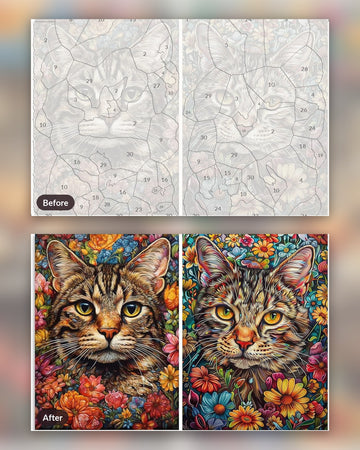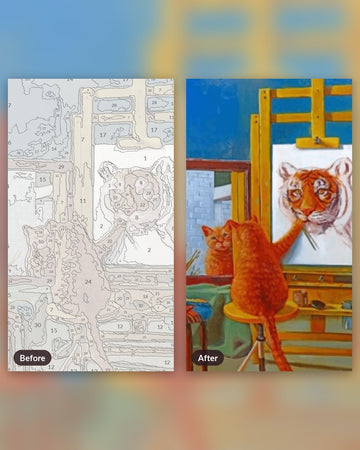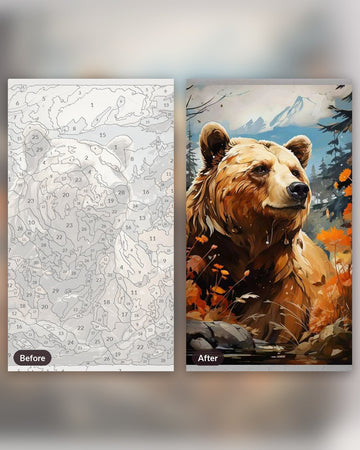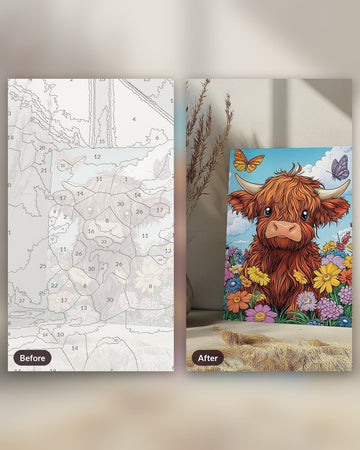
Almost every complaint about coverage has the same cause: one thick coat instead of two thin ones. Acrylic was not designed to be laid down like icing. It was designed to be built up, and a canvas painted in two passes looks better, dries flatter and hides the printed numbers more completely than the same canvas painted once with three times the paint on the brush.
This is organised by symptom, because that is how the problem presents itself.
The number still shows through
The usual culprit is a light color over a printed line, and the usual response is to keep adding paint until it disappears. That builds a ridge that catches the light for the life of the canvas.
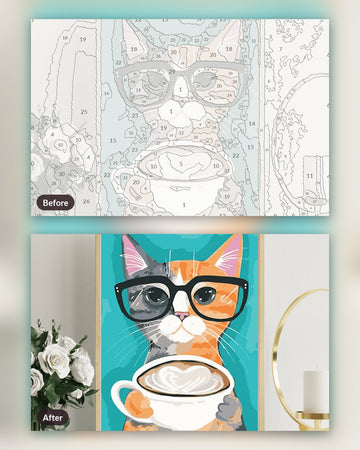
Do this instead. First coat: enough paint to tint the region, not to hide the line. Wait twenty minutes. Second coat: the same thin load again. The line goes under the second coat because the first coat has given the pigment something to sit on other than raw primer, and the surface stays level.
Pale yellows, pale pinks and anything approaching white are the worst offenders, because those pigments are the least opaque in the box. On a canvas like White Rabbit, where most of the animal is painted in five near neutrals, assume every one of them needs two coats and plan the evening accordingly.
The color looks patchy when it dries
Acrylic darkens slightly as it cures, and it darkens unevenly if the film is uneven. Thick in the middle of a region and thin at the edges gives you a halo.
Load the brush, offload most of it on the pot rim, then work the region from its perimeter inward. The edge gets the driest brush and the centre gets what is left, which is the opposite of what feels natural and produces a flat film.
The paint dragged and left brush marks
The pot has gone tacky. Acrylic in an open pot starts to skin within the hour, and a skinned paint will not level itself.
One drop of water, stirred with a cocktail stick, not with the brush. Water in the brush carries into the next region and dilutes the wrong pot. If the pot has gone past rescue, it has gone, and the thirty day guarantee covers a kit that arrived with dried pots in it.
Two colors bled into each other
You painted the second region before the first had set. Fifteen minutes is touch dry; edge to edge contact needs closer to thirty.
The way round it is to work in scattered order rather than in sequence. Paint every region of one number across the whole canvas, then move to the next number. By the time you come back to a neighboring region the first is dry, and you also finish each color pot in one go instead of opening it six times. On a busy canvas like One with Nature this single habit removes most of the bleeding.
Dark over light, or light over dark
Dark over light covers in one coat. Light over dark does not, ever, whatever is written on the pot. So when two regions meet and you have to choose an order, lay the dark first and bring the light up against it.
The same logic applies at canvas scale. Start at the highest numbers, which are almost always the darkest tones, and work towards the lightest. Everything you paint afterwards has an easier job, and the canvas stops looking like an unfinished puzzle much sooner. A gradient heavy kit such as Ocean's First Light is where this is most visible: painted dark to light it reads as depth, painted at random it reads as stripes.
It has gone wrong anyway
It is recoverable more often than people think, including regions painted in the wrong color entirely. The methods are in our guide to fixing mistakes.
Where to practise
These habits are easier to learn on large regions than on small ones. The beginner friendly range is built around that: fewer regions, bigger areas, strong color separation. A custom canvas from your own photograph is worth saving until the two coat habit is automatic, because a portrait is the least forgiving surface in the catalogue.