

















Johannes Vermeer painted maybe 34 pictures in his whole life. Girl with a Pearl Earring, done around 1665, is the one everyone knows, though for centuries almost nobody did. It vanished into obscurity, sold at auction in 1881 for about two guilders (roughly the price of a decent dinner), and only clawed its way to fame in the twentieth century. It hangs now at the Mauritshuis in The Hague, and unlike the Mona Lisa it is not really a portrait of anyone. The Dutch called this kind of thing a tronie, a study of a face and an expression, a costume, a mood, not a specific person.
What you remember is the turn of her head, the parted lips, that huge soft pearl, and the way she emerges out of pure blackness. Vermeer used expensive ultramarine ground from lapis lazuli for the blue turban, which was a wild extravagance at the time, and a warm yellow for the drape behind it. Blue and yellow, light and dark, almost nothing else.
Want to paint this yourself?
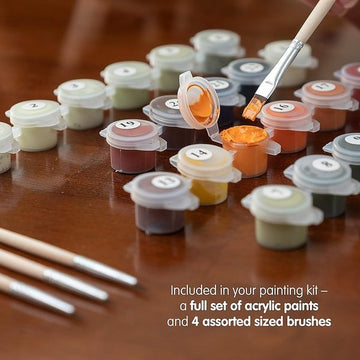
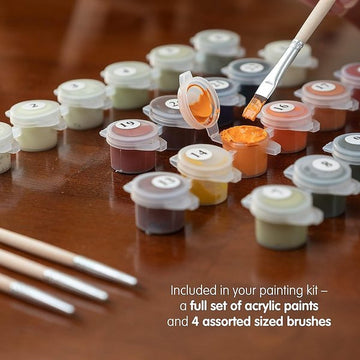
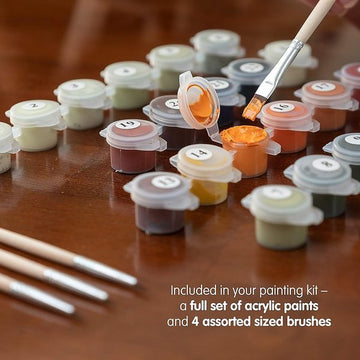
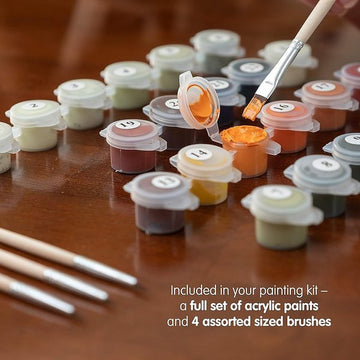
Turn one of your own photos into a numbered canvas (from $19.95). We trace it, mix the paints to match, and ship the kit with brushes.
Or pick a ready-made design:
- Whales And Girl Painting by Numbers Premium Kit (from $19.95)
- Lips Expression Painting by Numbers Premium Kit (from $19.95)
- Little Girl And Rabbit - Premium Art Kit (from $19.95)
Why it is close to ideal for a kit
This is the portrait I would actually recommend to someone recreating a masterpiece for the first time. The composition is simple. One face, one turban, a black void, no busy background, no crowd of details fighting for attention. The dark backdrop hides small imperfections instead of exposing them. And the color story is so clear that it teaches you something about how light works while you paint.
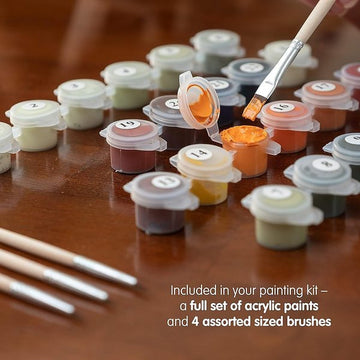
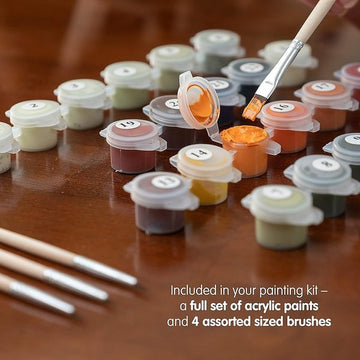
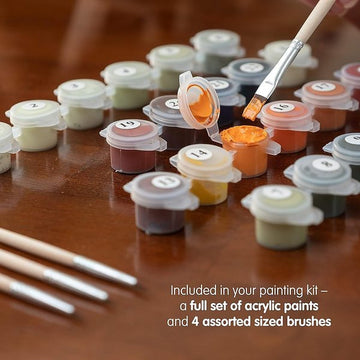
Kits tend to run a moderate 24 to 32 colors, weighted toward warm skin tones, the ultramarine and gray-blues of the turban, and a whole family of near-blacks for the background. A 40x50cm canvas is plenty. Most people finish in 12 to 18 hours, faster than a Monet or a Mona Lisa because so much of the canvas is that quiet dark field.
The face, the turban, and that pearl
Paint the black background first. It is large, forgiving, and it frames everything you do afterward. If you want the void to feel deep rather than flat, the layering approach in our guide to layering for better coverage stops it going patchy in raking light.
The face needs soft blending along the lit cheek and the shadowed side, the same nearly-dry-brush trick that any good portrait needs. Our faces and portraits walkthrough covers the exact motion. Keep the lips gentle, the highlight on the lower lip is what gives her that just-about-to-speak look.
Then the pearl. It is not really a detailed object, it is two dabs of paint, a soft gray-white glow on top and a smaller reflected light at the bottom. Do not overwork it. Lay the base tone, let it dry, add the single bright highlight, and stop. Beginners always want to keep fiddling with the pearl and it always gets worse. Understanding why those two dots read as a shining sphere is a nice lesson in itself, and if the logic of light and shadow is new to you, our color theory basics makes it click.
On the wall
Because the background is black, this canvas frames like a dream. A plain dark or thin gold frame and it looks like it walked out of a gallery. It suits an entryway or a dim, moody corner where the light on her face does the work. Do not hang it somewhere blasted with sun, the whole appeal is the glow against shadow.
A word on the light you paint under. Vermeer's whole game is a single soft glow falling from the left, and you will judge your skin tones wrong if you work beside a warm lamp or in yellow evening light. Daylight, or a neutral white bulb, keeps your color decisions honest. The saffron drape behind her shoulder is the one warm note that balances all the cool blue, so do not dull it down. And leave the tiny bright catchlight in her eye and the flick of light on her lower lip for the very end. Those two specks are what turn a painted face into a person about to speak.
Her kit lives in our portrait and people collection, and if you want to see what else from the great museums works at home, browse the full best seller lineup. Start with the girl. She is more forgiving than she looks, and finishing her feels like getting away with something.